Idowu Adegbilero-Iwari on ResearchGate

AdSense

Friday, June 9, 2017

Nigeria: Concerning Library Culture or is it Reading Culture? Part2

So what can we do? What can the government do? What can wealthy elites and business corporations do? Lots, can everyone do.

First, the nomenclature of public libraries must forthwith be changed. It is only in Nigeria you call libraries Library Boards. That name is synonymous to the low ratings and poor performance of the sector. They are called libraries, community libraries, public libraries, school libraries, so-so and so library; and not boards nor the least library boards. What’s in a name? Lots are in it. Public libraries serve the generality of the public and are established majorly with tax payers’ money or common government resources. According to an IFLA document:

A public library is an organization established, supported and funded by the community, either through local, regional or national government or through some other form of community organization. It provides access to knowledge, information and works of the imagination through a range of resources and services and is equally available to all members of the community regardless of race, nationality, age, gender, religion, language, disability, economic and employment status and educational attainment.

So, it is imperative to call a lion by its name, public libraries, pronto!

Secondly, and most pertinently, the Nigerian National Assembly must immediately enact an Act of parliament on Library funding. The Act can be called the Library Funds Act (LFA) which will enable the Executive arm of government to appropriate funds for library development in every fiscal year. The Tertiary Education Trust Fund (TETFund) has, under its legal responsibility to higher institutions, being stealthily supporting academic libraries and have so far spent over 25 billion naira on them. This in no small measure can account for the stark difference between the public libraries and academic libraries. So, the LFA is seriously needed not only to bridge the gap between public and academic libraries but to also leverage the creativity of librarians in public libraries and the potential of public libraries to transform the national literacy rating positively. The LFA will also afford all library types to seek and get funds for innovative library projects across the federation.
The National Assembly building: Nigeria

Also, states Houses of Assembly should do same. In this sense, the Library Boards may stay but empowered with budgetary and monetary powers to fund public libraries in each community in the states. I am also beginning to wonder why local government authorities have taken it as odium to do this common good called library for the people they serve at the grassroots. Let it be known that any grassroots governance without library projects is best a grazing endeavor of the roots of the masses. This must stop.
Still with the government, an immediate state of emergency must be declared on Library and Reading. This also coupled with the establishment of a National Agency for Reading (NAR). Thes political will must be demonstrated to drive up library development, library and reading culture.

Apart from government, wealthy elites and business corporations must divest their corporate social responsibility to this vital area. MTN has made efforts in the past with their MTN Foundation e-Library Project. Zenith Bank is trying to come up with something now under their “Adopt a Library” project. But more still need be done. I am looking forward to a wealthy elite like Andrew Carnegie who will devote substantial personal fortune as funds for building public libraries across Nigeria. They can establish foundations and allow for competitive bidding from government agencies, NGOs, communities and individuals.

Also, in this era of Reality Shows, shows in reading and literacy underscoring the values of libraries can be sponsored on network or national television stations by corporate organisations. Still on the role of the entertainment sector, Nollywood can have what I call “Nollywood Year of Reading (NYR)” where films and soap operas are devoted to Reading and Library. The NYR can come up every 5year or 3year to start with. 
And finally, reading campaigns by libraries, librarians, and library associations in addition to the efforts of the National Library of Nigeria must be taken with alarming seriousness. Sponsorship deals for such campaigns can be sought and reached with companies and renowned brands or even famous personalities such that Library and/or Reading Ambassadors are signed on to a library promotional campaign.

If we begin like this, and take some of these measures, the library cum reading culture will have good fate and the outcome will be enormous. Perhaps, just like in America, investment in Nigerian libraries may become another “leverageable investment” that the National Assembly “makes across national budget”.

As for me, my decision has long been made: I can build a community public library for Ijan-Ekiti, my hometown. I can do so much more. You can support me to do just these.

Thursday, June 8, 2017

Nigeria: Concerning Library Culture or is it Reading Culture? Part1

Model, Headquarters of the National Library of Nigeria that is under construction
This past week, at the tail end of May 2017, two events happened simultaneously mid-week. One in the USA and the other here in Nigeria; both concerning one theme- library/literacy. All these happened at the time my mind was preoccupied with library development in Nigeria. While in the USA, the President of the American Library Association (ALA) Julie Todaro, Ph.D., was in the last few days of her dogged fight against congressional cut in library funding for FY2018, Prof L. O. Aina, a former National President of the Nigerian Library Association (NLA) but present CEO of the National Library of Nigeria (NLN) marked the year 2017 reading promotional ritual. And as the tweeter handle of the NLN made several tweets of the key points of his reading, I remembered coming across ‘’reading culture in Nigeria is poor’’ https://twitter.com/Librarygovng. This coincided with my blog post few minutes earlier titled “Supporting FY 2018 Funding for Library Services and Technology Act (LSTA) and the Innovative Approaches to Literacy (IAL) program: the Plea of a Foreigner” where I compared the excellent reading culture of the Americans with the near nil culture of reading on this side the Atlantic. You can imagine how happy I was to be so corroborated by such an authority in Nigerian and African library science scholarship. So, it is a fact that Nigeria has poor reading culture. Although, the National Librarian went on to underscore the values of reading to leadership and national transformation but I quickly interjected the tweet reads by replying to one of the tweets thus: ‘’Reading culture cannot thrive without library culture’’ https://twitter.com/adegbilero.
There I began to query myself, is there any phrase in library lexicon as library culture? What is library culture? But something told me that I might be right from the tweeter reactions I got for my tweet; the Like, Retweets and all that. But really, what is library culture? Which one do we really need, library or reading culture? I will, thus, attempt to solve the puzzle I have tasked my mind to answer.  
Culture, in its presumptuous and generic sense connotes the total way of life of a group of people. Applying this to reading or library, a very convenient and unequivocal sense may be discerned for reading culture or library culture. But if giving definitional explanation is what this writ is all about, it may as well not worth the effort you have committed to reading it this far. Howbeit, it need be said that such basic note of understanding need be resounded.
My thought of library culture sends me back to the Spring of 2016 when with four other early career librarians from Bangladesh (Shaharima Parvin), the Philippines (Rhea Jade Nabusan), Kenya (Penninah Musangi) and Serbia (Zeljko Dimitrijevic) including my humble self from Nigeria (Idowu Adegbilero-Iwari) under the prestigious Jay Jordan IFLA/OCLC Early Career Fellowship programme explored library and experienced librarianship in the USA for a period of one month. This we did, among other things, through interactions in trainings, presentations, visits to libraries, museums and archives across the states of Ohio (host state), Illinois, Indiana and Washington, District of Columbia. There and then I saw what I call library culture. 
Library culture, apart from the traditional way of life of libraries, is more rather than less the total way of life of the people or the society the library serves in relation to the library. It is obvious what gallant attitude and disposition the American society have towards libraries. The people could rarely live without libraries. A community is not complete in America without the library.
Albany Public Library
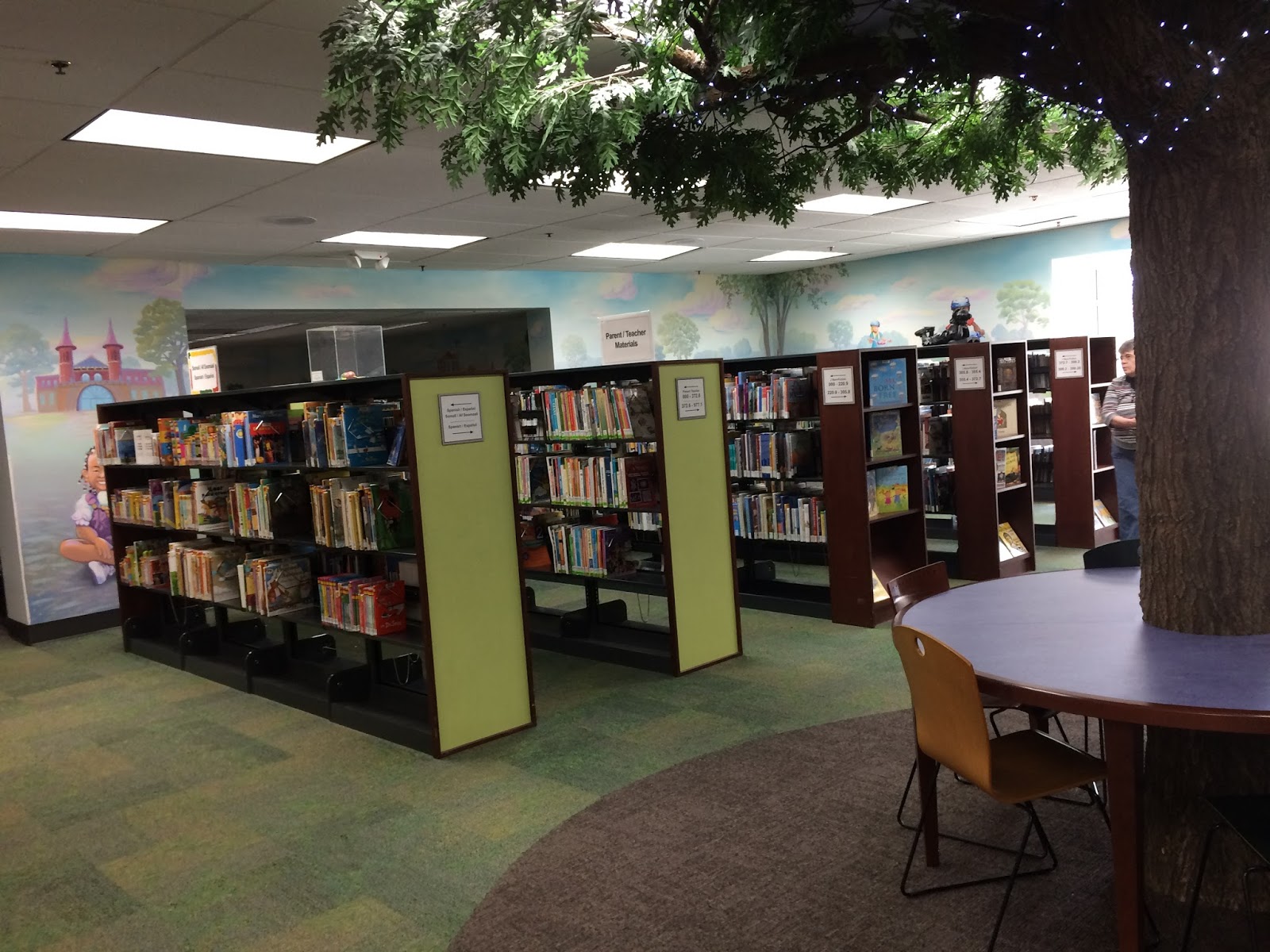
There just must be somewhere for the kids, teens, the youth, working class people, scholars, displaced people and just any human to go in the community to study, train, learn new technology, host events, learn government principles, pick up forms, explore historical events and archival events, freely use the internet, borrow books and now equipment and have fun generally. That is the nature of the modern American libraries. No wonder the libraries are no more principally about books but space for knowledge acquisition, creation and recreation. Modern information structure is hyper in nature and it is beyond what is printed in black and white. Information comes in different formats and now in different ways; and the more visual and / or handy or rather interactive the better for today’s information users. The multimedia and hyperlink nature of electronic information available through the World Wide Web on the Internet has further challenged libraries to double up on their services. These, have all been adequately and continued to be so taken care of by so many libraries in the US.
The design and architecture of libraries justifies the high premium placed on libraries.
Atrium of the Columbus Metropolitan Library
The support of the American people and government can only result in librarians’ creativity and innovation such that library users are now consider as customers who must be duly satisfied. Satisfied with comfort; satisfied with convenient services and structures; satisfied with aesthetics and beauty; satisfied with efficient and effective librarians. The library seems to always be ahead of the people, creating pleasant services to ultimately keep them coming to the library or using library services. Little wonder, that libraries now circulate (loan out) items more than books. These include: bicycles, sewing machines, mobile internet modem, and other technologies. Libraries now have space for creation and fabrication such as Makerspaces or Fablabs. Libraries have spaces for babies and nursing mothers. They possess such facilities for training and meeting. Such times for oral tradition and narratives (story telling). And as the American people sip the precious flow of library’s juicy offerings, the libraries are inundated with crowd of knowledge lovers and a reading people. Such is the library culture I meant to talk about.
A burgeoning library culture that does not leave out business, corporate organizations and wealthy elites where everyone sort of get really involved in one of the most critical sector that has remained ubiquitous across varying seasons and eras of human civilizations. There are countless endowment funds for various library projects across the country. Apart from the multi-million dollars congressional annual Federal Budget for Institute of Library and Museum Services (IMLS) under the LSTA Acts, state governments also have annual budgetary provisions for libraries in millions of USD. These are not without endowment from foundations and corporate businesses. The Carnegie Corporation of New York is a foremost and the leading global force behind libraries, library education and librarians. Their footprints are in libraries across the US and almost all the continents of the earth. The Mortenson Company has also committed fat bags of dollars to the course of library and librarians both in the USA and offshore. Bill and Melinda Gates Foundation have also taken deep love for libraries with rich supports globally. This is to mention but a very few. This is the library culture I meant to say from the onset of this essay and the reason for my thesis that “reading culture cannot thrive without library culture”.
To finally delve into the value of the library to the Americans, the Corporate Committee for Library Investment (CCLI) recently described the library as “very much critical national infrastructures: ubiquitous, indispensable, and economically essential. In canvassing for federal funding for libraries, CCLI further submitted that “library funding may be among the very best yielding and most leverageable investment that Congress makes across the entire Federal budget”. Their position can be easily understood given the following mind boggling statistics:

§  There are 25% more public libraries in the United States than Starbucks;
§  Each year, America’s more than 120,000 libraries of all kinds are visited 1.4 billion times nationwide (averaging to about 4 million visits per day or 2,663 visits per minute);
§  Those many millions of visitors come to modern libraries to borrow books, but also because libraries do (and have for decades been doing) so much more:
§  100% of libraries offer free access to the internet;
§  97% help patrons, including particularly veterans, complete government forms online;
§  90% train children and adults in computer literacy and other online skills;
§  73% aid patrons with job applications and interviewing skills;
§  68% help users use databases to find job openings; and
§  48% provide entrepreneurs and small business owners with online resources.
      Source: CCLI, 2017 at https://www.fundlibraries.com/ccli-letter

All these point to why the library culture of the American society is ably witnessed in its people’s love for reading.
Unfortunately, both the reading and library culture of the Americans sharply contrasts with Nigerians’. There is a common saying that “if you want to hide anything from a Nigerian, keep it in a book”. It is that horrible. The Nigerian National Librarian, as mentioned earlier, had once and again echoed the obvious, that reading culture is poor in Nigeria. The other obvious I need not mention is the poor library culture. According to a report of the Librarians’ Registration Council of Nigeria (LRCN), there are only 253 public libraries in Nigeria in addition to the 25 branches plus the headquarters of the National Library of Nigeria; altogether, 279, less than the 481 branch locations of the 251 Public Library Systems in the state of Ohio alone. And to put it into proper perspectives, the 279 public libraries and NLN branches are meant to serve over 170 million people in contrast with over 1993 public libraries and 2 branches of the National Library of South Africa to serve 54 million South Africans. These are just figures (quantity) and no mention of features (quality). You may as well spare me that ado. My guess is that you will agree with me that the point has been made that Library culture in Nigeria is abjectly poor.
library development in nigeria
Olusegun Obasanjo Presidential Library, Abeokuta

Save for recently reported refurbishment effort of the Isolo Public Library by the Lagos State government in conjunction with Zenith Bank Plc under the bank’s “Adopt a Library” scheme, the renascent Akwa Ibom E-Library, the Kenneth Dike Central e-Library in Awka, Anambra State, which are government efforts; and save for a very scanty private individual efforts like the only notably known Olusegun Obasanjo Presidential Library, Abeokuta, Ogun State, which are all modern; it is hard to imagine the state of public libraries in Nigeria. That said, must we continue to mourn this poor culture? Certainly, NO! We must act or rather make people act and promptly too.

Continue to read from Part2 here
Reach author

Wednesday, May 24, 2017

Supporting FY 2018 Funding for Library Services and Technology Act (LSTA) and the Innovative Approaches to Literacy (IAL) program: the Plea of a Foreigner

All along, since Julie Todaro, the American Library Association (ALA) President started the campaign to win the support of the Congress against cuts in funding of Libraries for FY 2018 in the Federal budget, I just felt there is little I could do, for certain reasons:
1. I am an international member of the ALA, a non-US citizen, a non-permanent resident at that;
2. in close relation to the above is the major focus of the campaign, which is aimed at getting the Senators representing our constituencies to support library funding. This could be done by visiting their offices, phoning or tweeting them among others. Though, I did one or two general tweets but never to a senator since you can guess why.
I am not equally surprised at the campaign and the passion with which the ALA presidents is handling it especially coming on the back of FY 2017 when the Institute of Museum and Library Services (IMLS) through the Library Services and Technology Act (LSTA) got a $1 million increase over FY2016. Naturally, given the continuing achievement of libraries and the important role they play in American civilization, one would have imagined a further push in federal funding. Alas! the reverse is the case. And to nip the actual reverse in the gains made by libraries over the years, we all really must get the Congress to stop any unwarranted cut through this campaign or protest sought of.
But a reflection on the whole campaign last night got me thinking of what I could really do on my own part, and unfortunately, a day or so to the deadline. I can write a blog post. I can speak up in defense of what I fancied most about America, the Library and her excellent reading culture. Excellent, compared to near nothing culture of reading on this side of the Atlantic. So, I remembered the memoir I posted on my blog- Journey to the Largest Library in the World and the Need for a Library-Conscious Nigerian Society. 
I remembered what I saw during library visits at the Spring-turned-Winter of 2016 in communities and institutions in the states of Ohio, Indiana, Illinois and the DC. I remembered how fascinated I was about the devotion of the people, very young and very old, to reading and the commitment of governments, individuals, and corporations to library development. I remembered seeing libraries as the epicenters of communities, the hub for citizens and students' square and enduring symbols of their civilization. I remembered, in particular, the excitement with which a bartender at a restaurant in Downtown/Magnificent Mile, Chicago, upon discovering that we are librarians said "I love library". He even went on to query the five of us, 2016 IFLA/OCLC Fellows and two of our program coordinators, "what is your favorite book?" He told us his own and narrated with excitement some of his "bad" library habits. There I saw a busy bartender loving the library and book. I remembered the great investment that must have gone to developing library infrastructure which most often than not are deliberately intended as legacies and monuments of the communities they serve.
Little wonder, libraries are seen as "critical national infrastructure" by over 80 companies which President Todaro reported to "have now signed CCLI’s May 17 letter to all Senators explicitly asking them to sign the LSTA and IAL Dear Appropriator letters and making the economic case that libraries are “critical national infrastructure.”
All the successes of a library friendly society that I saw in America can be directly traced to the love and funding support of governments for libraries. This is captured in the words of one of the fathers of America, Thomas Jefferson, who famously said "I can not live without books". This inscription boldly expressed on the wall of his section of the Library of Congress has remained a huge impetus for my push for a reading Nigerian society. And since my return from the USA, my overall attitude towards library development have changed. All I want government or anybody with the means to do right now, and just like an inspiring great American, Andrew Carnegie, is to fund and develop libraries for and in every town and village of Nigeria. I am already thinking of engaging Nigerian government to establish Library Fund to facilitate rapid library development and to enshrine reading culture into the Nigerian society. I have, as a matter of fact, already drafted a proposal for a library-based community initiative for self-revolution and civilization built upon knowledge through library and books. I am eagerly waiting for anyone to support this my big dream for Ijan-Ekiti, my hometown. Moreover, I am already thinking of how I can engage government, corporate organisations, the Nollywood and others to revolutionize reading, love for library and imbibing of the book culture in Nigerians especially the younger folks.
All these are inspired by my visit to American communities and libraries. They came from what I learnt of a government and society that is based on library. I am now wondering what damage this cut in federal library funding will do, not only to the American reading populace but to us, the rest of the world, who gain inspiration and gather momentum for knowledge from the enviable heights America have reached with her libraries and literacy. The damage will just be collateral!
Please, Congress and everyone else that matter on the Capitol, #Support LSTA/IAL for further breakthroughs in America and global inspiration, I plea!


Wednesday, April 26, 2017

Public Library as Community Hub: Modern Library Services to Catalyse Personal and Community Development

A Poster accepted for presentation at the 2nd AfLIA Conference& 4th African Library Summit, to hold 14th -20th May, 2017, Yaoundé, Cameroon
Modern Library Services to Catalyse Personal and Community Development
Adegbilero-Iwari's Poster

I am seriously thinking Public Library revolution for the evolution of African and Nigerian development. Support this revolution and make libraries do more. Remember, no nation or people can develop beyond her libraries (knowledge base).

Tuesday, April 11, 2017

Journey to the Largest Library in the World and the Need for a Library-Conscious Nigerian Society

LOC
Library of Congress: Inside
Either an alien in the country of books or my journey to the world’s largest library or something, I don’t really know what to call my writing. For the records, the care I received from the Americans that I had contact with dissuaded the thought that I was a stranger. But the stark parallel line between their excellent book culture and our… made me feel like an alien in the country of books. And of a truth, it was a great height of achievement in my professional capacity as a librarian to find myself in the revered Library of Congress, world’s largest library, in the company of four other young and promising librarians from developing nations of the world as 2016 Jay Jordan IFLA/OCLC Fellows.
Adegbilero-Iwari Idowu as IFLA/OCLC Fellow
2016 IFLA/OCLC Fellows
It all began late into my pursuit of a bachelor’s degree in Agriculture with a specific interest in Animal Production and Health at the renowned University of Agriculture in Abeokuta, South-west, Nigeria. I began to see my consciousness of the state of books whenever I entered the ‘Nimbe Adedipe Library, a gigantic building at the heart of the university widely regarded as the nucleus of the growing campus. I noticed my urge to read things outside agriculture. But most importantly, my urge to correct a poorly appearing book became noticeable.  When even my most cherished book, the Bible, has any folds, I quickly straightened it out. Little did I know then that I will sometimes in my life have to be a custodian of books as a Librarian, the challenge I took on myself to undertake upon the counsel of my dear aunty and her husband. I am so grateful I heeded that counsel.
Adegbilero Idowu on the Capitol Hill, Washington, DC.
I am, today, a Librarian, a Certified Librarian of Nigeria (CLN) with International exposure. I have been graced to experience Librarianship and see Libraries in Nigeria, South Africa and the USA. The latter, being the latest experience, got me both exceedingly crestfallen and excited. Heartbroken each time I moved from library to library either in the State of Ohio, Indiana, and Illinois or in the capitol. Appalled because my mind was back at home, Nigeria; appalled for the 180 degrees difference between our libraries and those libraries; appalled for the 180 degrees difference between the two societies with respect to books. The difference is like the one between darkness and light or the crest and trough of mountains. My sorrow swelled not only for the states of things back home but for the failure of our leaders who often come to the US and such countries but perpetually closed up their minds from receiving the light that such visits bestowed. I can't even remember the last time Library Funding is a budget issue in the Federal, States and Local Governments annual appropriation bills.


Adegbilero Idowu visited Westerville Public Library 2016
Inside the Westerville Public Library
In America, library is the strength of the people. The libraries are the hubs of the communities. The library represents the city square, the common place for the people of a community. Little wonder, every community has its own library. In the state of Ohio alone, there are 251 government-funded public libraries compared to say 3 in Oyo State or 1 in the whole of Ekiti State that are functioning below standard or the 26 branches of the National Library of Nigeria across the federation.
Library cards are as important as the Green card to the citizens and residents of this country. Libraries are usually flooded with people of all demographics from babies, toddlers to the visibly aged and with corresponding services for all. Library Services are innovative and modern. The architectures are deliberately self-imposing, attractive and well lit. There are tech shops, FabLabs, coffee shops and self-service centers across the libraries. Libraries are beauties to behold and pleasant places to visit. The now becoming a fad glass walls in libraries to connect library users with events outside the library is novel. Libraries compete with hotels for aesthetics and beauty. Furniture for sitting and reading are exceptionally attractive and comfortable to use. And librarians are tech savvy.
Thompson Library, Ohio State University: Inside
For instance, in Westerville, a northeastern suburb of Columbus, Ohio, the Westerville Public Library, was like a technology shop. It arrested almost every known technology to serve its users. The Columbus Metropolitan Library, even though under reconstruction for expansion as at April with a target of June 2016 for completion, has already shown great display of eminence and the candour of a society that is about and committed to libraries. And further into the country side, the magnificent edifice known as the Indianapolis Public Library is awe of a building to glimpse. And about two hours’ drive away from it in sister state Illinois, the Champaign Public Library with her masterpiece architecture and all-round services, is a breathtaking library package for a reading society.
And to the world’s largest library, a national treasure situated on the Capitol Hill, the irrepressible Library of Congress with its three self-imposing buildings: the Jefferson building directly opposite the US Capitol, the James Madison Memorial building besides the Cannon House Office building, and John Adams Building on the other side adjacent to the US Supreme Court on the way to Hart Senate Office building. All three buildings on different streets interconnected underground are the pride and beacon of the American reading society. Thomas Jefferson’s famous quote “I cannot live without books” was an emblem on his personal collections’ section of the Library of Congress. The Library of Congress, as do the whole of Washington, District of Columbia is a Jerusalem of a sort for tourists from all over the earth. There the great memory of human civilizations lay in books, artworks and quotations on the walls. What an awesome experience.
Adegbilero Idowu at the White House
 But in all of these, my mind was at home. The National Library of Nigeria that is taking forever to construct and the ill-constructed, deficiently equipped and old books-stocked libraries across my country at home. Besides, my mind was inundated with precious ideas to turn things around suddenly. I was just wishing for the opportunity. I was just wishing I have the funds to start with a modern community library at Ijan-Ekiti, my birthplace. I was just wishing there could be an Andrew Carnegieamong our rich elites who could believe my dreams of a book and reading society. Andrew Carnegie built, of his personal wealth, a total of 2,509 Libraries between 1883 and 1929 across the world among which 1,689 were built in the Unites States. This is apart from his age-long endowment to global library education and development part of which I am a beneficiary as a Carnegie grantee to train at the University of Pretoria, South Africa in 2015. This is a challenge to the Dangotes, Adenugas, Otedolas of this great country. Dangote should just give me a modern library and Adenuga another, and see what we can do from there.
Whoever builds a library builds life. Whoever builds a life builds a culture. Whoever builds a culture, builds a history and a dome of wealth for posterity to draw. Consider my journey to world’s largest library an invite to build an Africa and a Nigeria full of the light that knowledge can radiate.  And finally, our collective aspiration for development must be met with the resolve to base our efforts upon the reading of books and a library-conscious society. Just like Thomas Jefferson couldn’t live without books, our desired developed society cannot be realized without libraries.
By Adegbilero-Iwari, Idowu
Emerging Technology Librarian
Elizade University, Ilara-Mokin
Adegbilero tour of Washington, DC, April 2016
Ondo State, Nigeria
April 2017

Monday, March 20, 2017

Apply Now for ETD2017 Travel Scholarships

Applications are now being accepted for ETD2017 travel scholarships. Travel grants for delegates to attend the ETD annual symposium are an investment in ETDs worldwide. The application deadline is March 31, 2017. Complete information is available online at http://www.usetda.org/usetda-conferences/etd2017/travel-grants/.
Further information at http://www.ndltd.org/events/news/applynowforetd2017travelscholarships

Wednesday, February 1, 2017

Nigeria, Thee I Hail

 Nigeria I hail thee
Great nation, noble land
Great people, gallant minds
Great God, the Father of all

Thou art blessed, oh nation!
Thy vast land, thy glory
The endless resources of the greatest worth
These are thy richly crowns

Thy abundant human resources thy pride
Swarming thy soil like bee the hive
In tongue, though they differ, in tone one they art
In thy children, the nations art blessed

Thy geography is great, thy location perfect
In Africa, though biggest, the head thou art
In the world, a force; yea, a voice thou art
Nigeria, thee I love, Nigeria, my pride thou art

Thy many tribes thy colour
Thy various tongues thy crown
North and south home thou art
East and west, nay, a stranger never thou art

Forbid me if I talk of thy different people
Thy unity in diversity still will I praise
Farther a thought is thy various nations
All I see is the one, virile Nation, Nigeria thee I hail!

Friday, January 6, 2017

Left Alone: A poem

Left Alone
You picked whom you know
You helped your very own
You left me alone
To walk in the cold untold

You scurried off your car
You left me by my heart
To ponder o’er your act
But my heart did its art

And sang a joyous chorus
Though the cold perilous
But walked with gaily pleasure
To reach my throne glorious

Thursday, August 4, 2016

Herdsmen: A Poem

HERDSMEN
Herdsmen or hard-men?
Who are these that slay without restraint?
Who are these that thirst for blood?
Who are these that plunder the land?

Their herds destroy our land
Turning fields of greens to grounds of ruins
And giving our farms the semblance of siege
As if to say the locusts had stricken

Their hearts abhor our princely heads
They disdain our natural rights to life
They rebuke with the whip of death
Our courage to query their heinous deeds


At their might miles of farmland were thrashed
In their hands many a soul have ceased to breathe
Villages were razed and races aborted
These are not herdsmen but hard-men, the enemies of mankind.